
Monopoly Live Casino UK: How the Game Works
 Available in GB
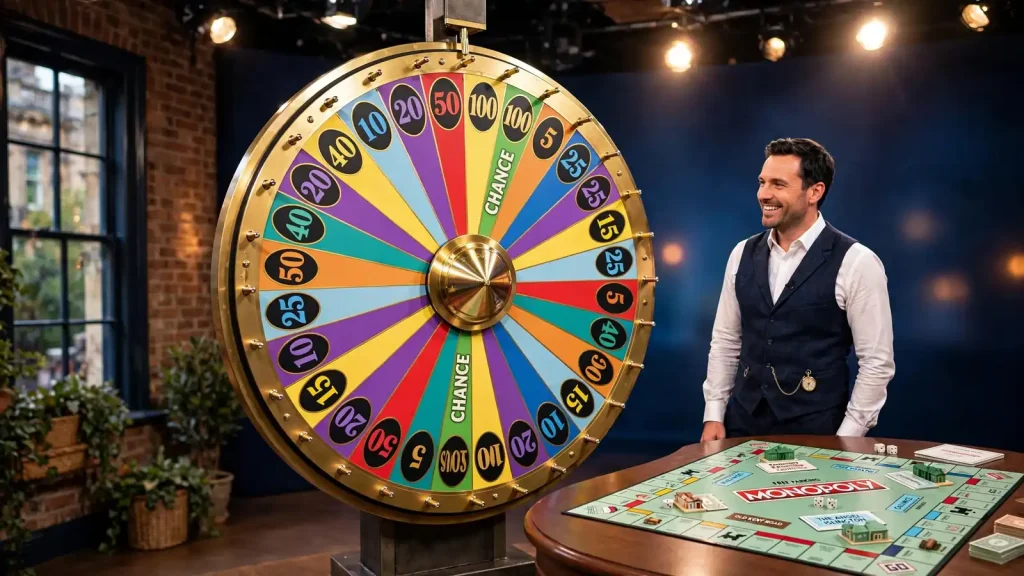
The game centres on a live studio spin, with numbered outcomes settling wagers and special segments potentially opening bonus features.
How Monopoly Live’s live-game format works
Monopoly Live combines a presenter-led wheel game with bonus features based on the Monopoly board-game setting. You watch a live studio feed, choose which outcomes to wager on, and then see the presenter spin the wheel. The result is the segment where the wheel stops. This makes the game feel different from a conventional live casino table: the central action is a wheel spin and its possible bonus events, rather than a dealer managing cards or a roulette wheel.
The wheel is the main part of the game. Its numbered segments represent possible base outcomes, while special segments can lead to additional features. Before a spin, you select the outcome or outcomes you want to back and set your wager. When the spin ends, the result determines whether your selection wins under the game’s rules. The presenter supplies the live-show element, but does not choose the result; the spin itself determines where the wheel lands.
A base result and a bonus feature are not the same thing. A numbered segment can settle a wager directly, while a special segment may change what happens next by opening a feature. The bonus sequences use a Monopoly-style board and familiar visual elements, but they remain part of the casino game’s rules rather than a separate board game. Their purpose is to add another stage of play after a qualifying result.
The wheel’s special segments can lead to different types of bonus play. In some features, a character moves around a board and reveals multipliers; another feature uses a different presentation and prize-reveal mechanic. The exact sequence depends on which feature is triggered. These events can make the game last longer than a single spin, but they do not turn the initial result into a player-controlled choice. You are watching the game resolve according to its rules, not deciding which spaces the character visits or what values are revealed.
Online Bingo in the UK: Cards, Slots and Prizes
This distinction helps explain the role of the Monopoly theme. The board, character and visual references make the game recognisable, but they are not evidence that a player can influence the result through knowledge of the original board game. Familiarity with Monopoly does not provide a tactical advantage in the live casino version. The relevant choices are the wagers available before play, while the wheel and any triggered feature determine the outcome.
A conventional live table usually centres on a dealer and a defined table procedure. In a card game, cards are dealt and compared or combined according to the rules. In roulette, the ball’s final position identifies the result. Monopoly Live instead combines a wheel outcome with show-style bonus sequences. The presenter, studio production and themed features are part of the format, while the underlying wager still depends on the game settling in accordance with its rules.
The live feed also affects how you experience the game, not what you control. You can follow the presenter and watch each spin as it happens, but the broadcast does not make a result more predictable. A previous wheel landing does not reveal where the next spin will stop, and a bonus sequence is not a signal that a particular outcome is due. Treat each round as a separate event rather than reading a pattern into the show.
It is useful to keep the stages clear: you select a wager, the wheel produces a result, and a qualifying special result may lead into a bonus feature. The feature then resolves under its own rules. Keeping those stages separate makes it easier to understand what you are wagering on and why a bonus event can occur without being the same thing as a direct win on a numbered outcome.
Monopoly Live is therefore best understood as a live wheel game with a game-show presentation and themed bonus play, rather than as a standard casino table dressed with a Monopoly logo. The show can make the action more elaborate, but the basic relationship remains simple: your selected wager is evaluated against the outcome produced by the game. If you choose to play, gamble only what you can afford to lose.
Attention: Familiarity with the original Monopoly board game does not provide a tactical advantage or allow you to influence the results in the live casino version.
What to check before playing Monopoly Live online
Finding Monopoly Live on a casino site is only one part of deciding whether to use it. You also need to know which business operates the site, whether it is authorised to serve customers in Great Britain, and what rules and account controls apply before you deposit. These checks matter whether you are considering a site described as an online casino with Monopoly Live or looking for a particular game.
Confirm the operator’s licence
Remote gambling businesses that serve customers in Great Britain must hold the relevant licence from the UK Gambling Commission. The Commission regulates online casinos as part of its oversight of gambling, and its authority over remote gambling does not depend on where the operator’s equipment is located. It is the sole regulator for commercial gambling in Great Britain.
Before depositing, verify the operator’s licence number on the Commission’s public register. Do not rely on a logo, a claim in the site’s footer, or a search result alone. A logo can be copied, and a company name shown on a website may differ from the legal name of the business that holds the licence. Compare the operator details on the register with the information on the casino’s own terms and conditions.
Check that the licence belongs to the business actually offering the gambling service, not merely to a similarly named company. Also compare the website address you intend to use with the domain information associated with the operator. A licence attached to one business or domain is not evidence that an unrelated site is authorised. If the details do not match or are difficult to establish, do not deposit until you have resolved the discrepancy.
Mines Casino Game in the UK: Rules and Risk
The Commission issues operating licences to businesses and personal licences to individuals working in regulated roles. For a player assessing an online casino, the key question is whether the business providing the gambling service has the appropriate operating authority. A personal licence or a general statement about regulation is not a substitute for checking the operator.
Identify who is responsible for your account
A brand name is not necessarily the legal name of the company running the casino. Look in the site’s terms, privacy information and account conditions for the operator’s registered business details. Those details should make clear which business accepts your account, handles deposits and withdrawals, and is responsible for complaints.
Read the terms that apply to the account before you commit funds. Pay attention to restrictions on account use, the circumstances in which a withdrawal may be delayed or refused, and the procedure for challenging a decision. The wording should identify a contact route and explain how the operator handles complaints. UKGC licensees must provide an internal complaints process and access to an approved Alternative Dispute Resolution service. If the site gives no clear route for raising a complaint, that is a practical reason to pause.
The same care applies to the site’s privacy information. You should be able to identify which business processes your account information and how to contact it about that information. If the operator’s identity changes between the registration page, terms and privacy notice, ask for clarification before creating an account or paying in.
Check account protections before funding it
A regulated casino should explain its safer-gambling controls in a way you can find and use. Remote operators must prompt new customers to set a financial limit before their first deposit and make account-level limit controls accessible. Check that the site describes these controls clearly and that you can locate them in your account information. A tool is useful only if its operation and effect are understandable.
Do
- Verify the operator’s licence number on the UK Gambling Commission’s public register
- Compare the website domain with the information associated with the licence
- Identify the legal business responsible for your account and complaints
- Set a financial limit before making your first deposit
Don’t
- Rely solely on a logo or a claim in the site’s footer to verify licensing
- Use an operator whose legal name differs from the registered licence holder
- Deposit funds before understanding the withdrawal and complaint procedures
- Assume that account opening is proof that all age and identity checks are complete
UK-licensed casinos must also provide responsible-gambling tools, including self-exclusion. Look for an explanation of how to activate the available controls and what happens after you do. The site should also provide information about support options. These protections do not remove the risk of losing money; they give you ways to set boundaries or stop access.
Operators are required to contribute to the Research, Education and Treatment levy. That obligation is part of the regulatory framework, rather than a reason to assume that a particular casino is suitable for you. Your own check should still focus on whether the operator is authorised and whether its account conditions and safeguards are clear.
You must be of legal gambling age, and operators are required to verify a customer’s age before allowing a deposit into a gambling account. Do not treat an account opening as proof that all checks have been completed. If the site asks for information to confirm your identity or age, use only the operator’s stated secure process and make sure you understand which business is requesting it.
Review payment rules and practical terms
Payment methods can tell you something about whether a site’s processes align with the rules. UK-licensed casinos cannot accept credit cards for gambling. This includes credit-card funding routed through a money service business, and operators cannot accept wallet payments where the wallet permits credit-card funds to be used for gambling. If a payment route appears to allow credit-card gambling, do not assume it is acceptable simply because the site offers it.
Online Keno Casinos in the UK: What to Check
Check the deposit and withdrawal conditions before transferring money. The casino should state which payment methods it accepts and explain any relevant account requirements. Read the terms rather than inferring them from the payment logos displayed on a page. If a condition is unclear, seek an explanation from the operator before depositing; do not rely on an informal assurance that conflicts with the written terms.
Consider whether the site’s identity, licence details, account protections, payment rules and complaint process all point to the same responsible operator. A polished page or a Monopoly Live listing cannot establish those things on its own. Nor does a large catalogue of games make a casino a better choice. The useful test is whether you can verify who is providing the service and understand the conditions attached to your account.
Make a decision before opening a balance
A search for the best online casino with Monopoly Live can produce claims about selection or convenience, but those claims do not replace checks you can verify. Treat statements about licensing as something to confirm on the public register, and compare the registered operator with the name and domain shown on the site you plan to use. If you cannot establish that connection, choose not to deposit.
Finally, decide in advance what amount you can afford to lose and do not exceed it. Gambling is not a way to earn income, and a licence does not make outcomes predictable or remove financial risk. If the site’s terms, protections or operator identity leave you uncertain, pause rather than letting the presence of the game rush the decision.
Licensing Risk
Do not deposit funds if you cannot establish a clear connection between the site’s domain and a current licence on the UK Gambling Commission’s public register.
How to start a Monopoly Live session
Starting a real-money session involves more than opening the game. You need to reach it through a suitable casino account, complete any required checks, and confirm the choices shown before play begins. The exact layout differs between operators, so treat labels and menus as site-specific rather than assuming every version works the same way.
Prepare your account
Use an online casino that is licensed to serve customers in Great Britain. Before depositing, verify the operator’s licence on the UK Gambling Commission’s public register and check that the registered business and domain match the site you are using. A familiar name or a search result alone is not confirmation.
You must be at least 18 to gamble online in the UK. The operator must verify your age before allowing you to deposit. If the casino asks for information or documents to complete its checks, follow the instructions on its own site; do not send sensitive material through an unverified message or link.
New customers must be prompted to set a financial limit before their first deposit, and account-level limit controls must remain accessible. Consider what you can afford to lose before choosing a limit, rather than adjusting it in response to a session. Only gamble with money you can afford to lose.
Choose a permitted payment method. UK-licensed casinos cannot accept credit cards for gambling, including credit-card funds routed through a money service business. They also cannot accept wallet payments where the wallet allows credit-card funds to be used for gambling. If you are unsure how a payment is funded, check with the payment provider before using it.
Online Casino Without ID in the UK: What to Know
Open the game
After signing in, go to the casino’s live-game area and locate Monopoly Live. A site may organise its games differently, so use the game’s displayed title rather than relying on a particular menu name or position. If several entries look similar, pause and confirm that you have opened the intended game before placing a wager.
A casino may offer access through a website, an app, or both; availability depends on the operator. Do not assume that an app exists just because the game is available online. If you use an app, obtain it through a channel identified by the casino itself, and check that the publisher and destination are correct before installing. If no app is offered, use the operator’s website instead of an unofficial download.
Once the game has loaded, take a moment to identify the information presented on screen. Check the displayed wager controls and any rules or help information available within the game. Interfaces can differ, so do not rely on instructions written for another casino’s version. If the controls or the amount you are about to stake are unclear, do not start the round until you understand them.
Begin only when ready
Select a wager only after checking the amount shown. Make sure it is consistent with the spending limit you set and with what you can afford to lose. The game may present options or controls that are specific to its current screen; read their labels rather than guessing what they do. If you need to change a setting, check the updated display before continuing.
Before Starting a Round
- Verify the operator’s UKGC licence and matching domain
- Set a financial limit you can afford to lose
- Confirm you are using a permitted payment method (no credit cards)
- Review the specific wager controls and help information on screen
- Double-check that the selected stake amount is correct
Then follow the game’s on-screen process to enter a round. Stay attentive to the amount selected and to the point at which a new round begins. Do not treat a sequence of previous results as a reason to increase your wager or to expect a particular outcome. When you have finished, leave the game and use the casino’s account controls if you need to review or change your limits.
Reading results and statistics without treating them as predictions
A record of Monopoly Live results describes what has already happened. It cannot, by itself, tell you what the next result will be. This distinction matters when you read a results page, follow a tracker or compare statistics: a list can be accurate as a historical record while having no predictive value.
A result is an observation from a completed game cycle. Statistics summarise a set of observations, perhaps by counting how often an outcome appeared or grouping outcomes over a selected period. Neither changes the process that produces a later result. Unless a published statistic is tied to a demonstrated mechanism that affects future play, it should be read as description, not as a forecast.
What a results history can show
A history can help you confirm which outcomes appeared during the period it covers. It may also make it easier to review a sequence than relying on memory. But the record has boundaries: it covers only the games included by that service, within its chosen time window, and according to the way it labels results.
Online casino tournaments in the UK: what to check
Check what the history actually records. Does it show completed outcomes, or does it also include other information? Is the time range clear? Does it explain how the displayed categories are defined? If these details are absent, you cannot tell whether two trackers are counting the same thing. Different displays may appear to disagree simply because one covers a different period or groups results differently.
A tracker can also be delayed or incomplete. Treat a result as confirmed only when the record identifies the game cycle it belongs to and the source explains how it collects its data. A stream of recent outcomes is not automatically a complete record, and an attractive chart does not establish that its underlying data is reliable.
Why a run does not make a prediction
People naturally look for patterns in sequences. If an outcome appears repeatedly, it can feel as though the sequence is due to change; if it has not appeared recently, it can seem overdue. Those impressions are not evidence of what will happen next. A past run does not create an obligation for a later game to balance it out.
Likewise, a short-term frequency is not a dependable estimate of what a future session will contain. A small sample can look unusually concentrated or unusually varied by chance. A larger sample may describe past behaviour more steadily, but it still does not tell you the next result. The distinction is between summarising observations and establishing a predictive rule.
A “strategy” based on following recent results therefore needs careful scrutiny. A tracker might help you organise what you have seen, but it cannot turn historical outcomes into control over future outcomes. Claims that a particular sequence signals a coming result should be treated as claims requiring evidence, not as conclusions established by the sequence itself.
A results history is a descriptive filing tool; it summarizes past observations but cannot be used to predict future outcomes or identify "due" results.
Reading statistics with their limits in view
Before relying on a statistic, identify its denominator: what set of games was counted? Then check the category definitions and the period covered. A percentage or ranking without that context can give a false impression of precision. If a service does not say how it collected or classified results, the figure is difficult to assess.
Be cautious with labels such as “hot”, “cold” or “due”. These are interpretations placed on historical data, not properties that guarantee a future outcome. The same applies to a leaderboard that ranks recent results. It may accurately order the entries shown, while saying nothing about which entry will appear next.
A tracker is most useful as a filing tool: it can make past results easier to inspect. It becomes misleading when its display encourages you to treat a sequence as an instruction for wagering. No historical chart removes uncertainty from a later game, and no result history should be treated as a reliable prediction service.
Rules, bonuses and decisions about wagering
Reading the rules is different from reading a results chart. Rules explain how a game is structured and how its outcomes are determined; statistics report observations from play. A bonus is a separate offer with its own terms. Neither the presence of a bonus nor a pattern in past results makes a future outcome more predictable. Check the relevant terms rather than assuming that a bonus changes the game’s underlying results.
Best Low-Volatility Slots in the UK
A practical approach is to decide in advance what you can afford to lose and not increase that amount because a tracker suggests a result is due. If reviewing results begins to feel like a reason to chase losses or extend a session, stop using the tracker and step away. Only gamble what you can afford to lose.
Great Britain stake-limit context
The stake rules for online slots should not be applied to Monopoly Live by assumption. A specialist review reports a Great Britain online-slot cap of £5 per game cycle for players aged 25 and over, and £2 per cycle for those aged 18 to 24. The same type of review distinguishes roulette and blackjack from slots for the purpose of those limits. These descriptions concern the named categories; they do not establish how Monopoly Live is classified.
The relevant question is therefore whether the game is treated as an online slot for the applicable rules, not whether a results page calls it a live game show or places it beside casino titles. Do not infer a legal classification from its presentation, a tracker’s labels or a strategy article. The stake limits described for slots cannot be confidently transferred to Monopoly Live without establishing that classification.
How Monopoly Live fits into the live casino game-show category
Monopoly Live sits in the live casino game-show category: it is presented as an entertainment-led game rather than as a digital version of a conventional casino table. The distinction is about the structure and presentation of the experience. A table game centres on a familiar format such as blackjack or roulette; a game show uses a more theatrical presentation and its own game rules.
Table Games
Centred on familiar formats like blackjack or roulette with defined table procedures.
Live Game Shows
Entertainment-led experiences with theatrical presentations and unique game rules.
Monopoly Live
A wheel-based game combining a live presenter with themed bonus sequences.
That difference matters when you compare titles. At a blackjack table, the central activity is playing hands under blackjack rules. At roulette, it is placing wagers on outcomes tied to the wheel. A live game show may still involve wagers and a casino-game outcome, but its identity is shaped by a separate format rather than by those established table procedures. The word “live” describes the streamed presentation; it does not make every live casino game the same kind of product.
Monopoly Live is one example of this broader game-show style. Other titles in the live casino landscape include Crazy Time and Dream Catcher. Their names identify separate games, not alternative versions of blackjack or roulette. A useful way to compare them is to look at what each game asks you to do, how its rules organise an outcome, and how much of the experience comes from a show-style presentation. The category label alone does not tell you the rules or whether a particular game suits you.
This also explains why a live casino can contain both game shows and familiar table games without treating them as interchangeable. A shared streaming setting does not erase differences in rules, decision-making or pace. If you are choosing what to explore, compare the actual game format rather than assuming that the live dealer, studio or casino branding makes two titles equivalent.
There is historical context for the wider live-casino landscape in the UK. Grosvenor first introduced its live casino games in 2013, with card and casino games such as Blackjack, Texas Hold’em and Roulette. That milestone shows that live casino offerings have included traditional table formats; it does not establish which game-show titles any operator offers today.
Plinko Casino UK: Games, Risk and Offers
A review of Monopoly Live should therefore separate three things: its game-show presentation, the rules that determine play, and the practical conditions of accessing it. Calling it a live casino game show helps describe its place among casino products, but it is not a quality rating or a guarantee about the experience at a particular site. Before wagering, decide whether the format and rules are clear to you, and gamble only what you can afford to lose.
Our top casino picks for the UK
- BeOnBetBonus: 100% up to €500 + 100 FS · Payout speed: 1-3 business days
- NightWinBonus: £900 + 400 free spins · Payout speed: 1-3 business days
- SlotoSportBonus: 500% up to £ 10 200+ 777 FS · Payout speed: 1-3 business days
- SpinFormulaBonus: 550% Up To £15,000 + 550 FS · Payout speed: 1-3 business days
- ZombillionBonus: Welcome Pack 250% up to £4000 + 200 FS · Payout speed: 1-3 business days
- NightLuckBonus: Welcome Pack + 805% Up To 6400€ + 280 FS · Payout speed: 1-3 business days
- JetsetspinsBonus: 200% Bonus + 100 Free Spins + Free Royal Wheel · Payout speed: 1-3 business days
- EvoSpinBonus: 125% up to €2500 + 125 Free Spins · Payout speed: 1-3 business days
- x3betBonus: Welcome Pack 100% Up to £1.000 + 200 Free Spins · Payout speed: 1-3 business days
Checking a casino site before you use it
A site offering Monopoly Live is only part of the picture: check which business operates it and whether the domain you are using is covered by that business’s Gambling Commission licence. A familiar name, a logo or a statement on the site is not a substitute for checking the public register.
Find the operator’s legal name and licence number in its terms or licensing information, then search for those details on the UK Gambling Commission’s public register. Confirm that the register identifies the operator and that the domain shown there matches the casino site you intend to use. A licence belonging to a related company does not, by itself, establish that the site’s stated operator or domain is covered.
A specialist review reported that the register dated 26 September 2026 did not identify a LuckyPays entry under that brand or its stated domain, including luckypays.io. Treat that as a dated register finding, not as a substitute for checking the register yourself: entries and business details can change, and claims should be verified directly before you deposit.
Caution: Do not rely on old register findings or third-party claims; always verify the operator and domain directly on the official public register before depositing.
The Commission regulates remote gambling offered to consumers in Great Britain, including where the operator’s key equipment is located elsewhere. If you cannot match the casino’s operator and domain to a current register entry, do not rely on the site’s own assurance that it is authorised. Resolve the discrepancy through the Commission’s register and official information before proceeding.
A register check is about the operator, not the game title. It can help establish whether the business and site are authorised to serve customers in Great Britain; it does not predict how a session will go. Only gamble what you can afford to lose.
What a Monopoly Live demo can and cannot tell you
A Monopoly Live demo, when a casino makes one available, lets you explore the game without staking real money. Its useful purpose is practical: you can follow the sequence of a round, see how the on-screen elements relate to one another and decide whether the presentation is clear enough for you to use. This can reduce uncertainty about the interface before you consider playing for money.
Treat the demo as a way to learn the flow, not as a test of what a real-money session will produce. Results shown during practice do not establish what will happen later, and a run of particular outcomes does not demonstrate that the same pattern will recur. Nor does a demo tell you whether a real-money session would leave you ahead or behind. Virtual play removes the financial consequence of a wager, so it cannot reproduce the effect of risking money on your decisions.
The demo also cannot establish that every control, setting or feature will appear in the same form in a casino’s real-money version. If something is unclear, use the information provided by the operator rather than assuming that practice play answers questions about real-money terms.
Keep the distinction straightforward: use a demo to understand what you see and how a round proceeds; do not use it to estimate future outcomes or make a financial decision. If you choose to play for money, set a limit you can afford and stop when you reach it. Only gamble what you can afford to lose.
Reviewing Monopoly Live and playing for free
A useful Monopoly Live review is a suitability check, not a promise about what a session will deliver. Consider whether you enjoy a live, presenter-led format, whether its pace holds your attention, and whether you are comfortable with outcomes that you cannot control. A game can be entertaining to watch without being a good fit for your playing habits.
Separate presentation from the decision to stake money. Ask yourself whether you would still enjoy the experience if a session produced no return. If the attraction depends on expecting a win, that is a reason to pause rather than increase a wager. Past results or an engaging presentation do not establish what will happen next.
Playing for free means taking part without staking your own money; it is different from reviewing the game. A review assesses features and personal suitability, while free play is an activity that may let you experience the game without a real-money stake. Availability and the terms attached to any free-play option can vary, so do not assume that every casino offers it or that it behaves exactly like real-money play.
You can review the game without playing at all. Consider what you want from a casino game, how much attention you want to give it, and whether its format suits you. If you choose to play for money, set a firm limit before starting and stop when you reach it. Do not treat a free session as evidence that real-money play will produce similar outcomes.
Online gambling in the UK is for adults aged 18 and over at sites holding a UK Gambling Commission licence. Gamble only what you can afford to lose; if that condition is not met, do not stake money.
Are online casino games licensed and regulated?
Yes. The UK Gambling Commission regulates online gambling, and remote operators serving consumers in Great Britain must hold the relevant licence.
Is LuckyPays licensed by the UK Gambling Commission?
No LuckyPays entry under that brand or its stated domain, luckypays.io, appears on the Commission’s public register dated 26 September 2026.
What are the online slot stake limits in Great Britain?
The limit is £5 per game cycle for adults aged 25 and over, and £2 for adults aged 18 to 24. These limits do not apply to roulette or blackjack.
Casino Games
Published by the Gransino Casino team.