
Online slot payout percentages: what they mean
 Available in GB
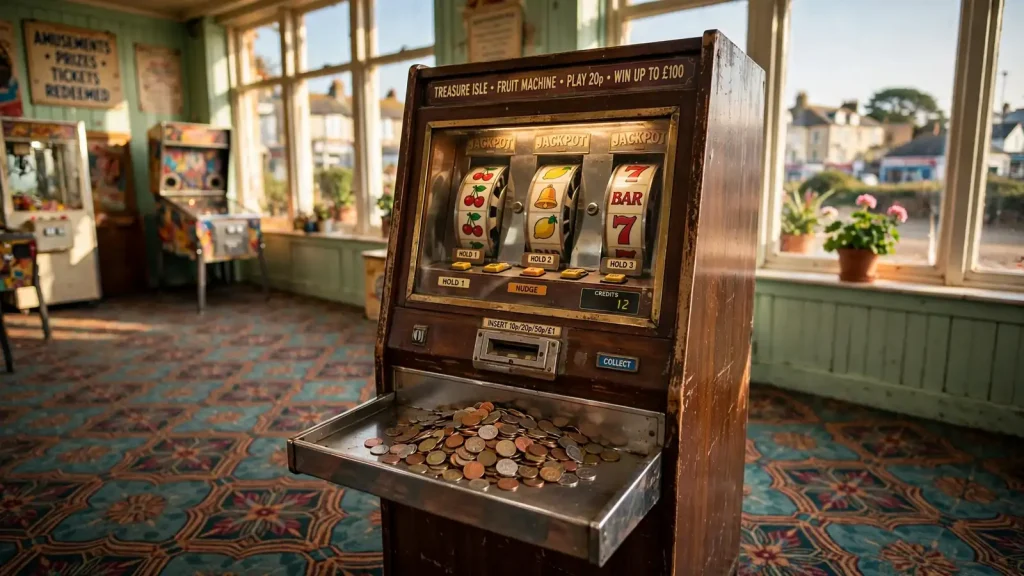
The figure compares winnings with stakes over extensive play, but does not establish an individual result or a game’s chance of winning.
What a Casino Payout Percentage Measures
A payout percentage describes the proportion of stakes that a game is designed to return as winnings over a large amount of play. It is a way to summarise the game’s return, not a promise about what any player will receive. The figure needs a clear subject: it may refer to one game, a particular version of that game, or a group of games. Without that scope, a percentage can sound more informative than it is.
The basic relationship is straightforward. Add the stakes placed on a defined game over the period or sample being considered, then compare them with the winnings paid back by that game. The payout percentage expresses the returned amount as a share of the stakes. It does not describe the operator’s total revenue, the size of a prize, or the chance that a particular spin will win. Those are different properties and require different information.
For a slot, the relevant figure would need to be tied to the slot itself and to the version being played. A casino-wide statement, by contrast, could cover many games with different rules, payout structures and stakes. Those figures cannot be treated as interchangeable. If an operator advertises a broad casino payout percentage, the important question is what games and results the claim includes. A figure without that boundary does not tell you the payout percentage of a specific slot machine.
The game is the unit that matters
A payout figure becomes meaningful only when its unit is defined. For a single game, the unit may be a named game and its particular settings. For a collection, it may be all games in a stated category or a wider selection across a casino. The broader the selection, the less directly the result describes any one game.
This distinction matters when comparing an online casino payout percentage with a figure shown for an individual game. A casino-level claim may combine returns from games that have different mechanics. The combined result can therefore differ from the return associated with any game in that collection. It cannot, by itself, identify which game has the highest return or establish that a particular slot has the best casino payout percentage.
High-Volatility Slots in the UK: How They Work
A useful comparison requires matching like with like. If one figure applies to one slot and another to a casino’s entire catalogue, they do not measure the same thing. Even two game-specific figures may not be directly comparable if they refer to different versions or conditions. The label “payout percentage” is not enough; the scope and basis of the figure determine what it can support.
The same caution applies to broad claims about an “online casino with the highest payout percentage”. A casino-wide ranking would need a consistent definition of which games are included and how the combined figure is calculated. Without those details, a headline may compare unlike totals or present a selection of games as though it represented the whole casino. A broad percentage cannot substitute for a game-level comparison.
What the percentage leaves out
A payout percentage compresses many outcomes into one summary. It does not show how the game’s prizes are distributed, what combinations produce them, or how often different outcomes occur. Two games could have the same stated return while having different prize structures. The percentage alone cannot tell you whether a game’s returns come from frequent smaller prizes, less frequent larger ones, or another distribution.
It also does not describe the mechanics that lead to a win. A slot’s rules determine which symbol combinations pay and how prizes are calculated; the payout percentage summarises the resulting return rather than explaining each rule. To understand the game itself, you need its paytable and rules. To understand the percentage, you need to know what version it applies to and how the figure was established.
This is why a slot machine payout percentage should not be read as a general rating of the whole casino. A casino may offer a range of games, and their individual figures can differ. A single overall value would be a summary of a chosen group, not a property that every slot in the casino shares. Nor does the percentage tell you whether a casino’s games are suitable for your preferences: that depends on features and rules the figure does not capture.
Attention: A payout percentage is a summary of long-term returns and does not guarantee the specific amount any individual player will receive.
A separate example: online keno
Online keno illustrates why a return figure must be linked to a particular game and its rules. Its payouts depend on the stake and on how many of the numbers selected by the player appear in the draw. The possible return is therefore connected to both the selection and the draw result, rather than being a universal percentage that applies equally to every way of playing.
A specialist gambling review has reported an online keno house-edge range of approximately 5% to 25%, with the result depending on the number of spots selected and the casino. That is a sourced keno estimate, not a general market standard, and it is not a slot payout figure. It should not be used to describe slot machines or to infer an online casino’s overall return. The example shows why a percentage must travel with its game type and the conditions that affect it.
For keno, the draw process also matters: each draw is independent, so earlier results do not change the numbers in a later draw. That fact concerns how the game operates; it does not turn the reported range into a casino-wide measure. A figure tied to keno remains specific to keno, just as a figure tied to one slot would remain specific to that slot and version.
Online casino tournaments in the UK: what to check
Reading a casino-level claim
When a casino promotes a return figure, check the claim’s subject before comparing it with another number. Does it name one game, a category, or the casino’s games as a whole? Does it explain which games are counted? If those boundaries are unclear, the figure cannot reliably answer a narrower question, such as how a particular slot is configured.
A casino-wide figure may also depend on which games contribute to the calculation. If a selection is used rather than the full catalogue, the result describes that selection. If a mix of game types is included, the total combines different rules and payout structures. The number may still summarise that defined group, but it should not be mistaken for the return of every game in it.
For a game-level comparison, identify the exact game and version first, then look for a figure that applies to that same version. The name of a casino is not a substitute for this information. A casino may host games with different returns, so describing it as having the “best” payout percentage without specifying the measure can obscure the distinction between an operator-level claim and a game-level figure.
In practical terms, treat a payout percentage as a scoped description: it belongs to the game, version or defined collection it measures. The broader the claim, the more carefully you need to identify what has been grouped together. That keeps a casino-wide statement in its proper place and prevents it from being read as a slot-specific value.
Do
- Match like-with-like when comparing figures
- Identify the exact game and version first
- Check the claim’s subject and boundaries
Don’t
- Use a casino-wide figure for a specific slot
- Treat different game versions as interchangeable
- Mistake a broad headline for a game-level comparison
Our top casino picks for the UK
- BeOnBetBonus: 100% up to €500 + 100 FS · Payout speed: 1-3 business days
- NightWinBonus: £900 + 400 free spins · Payout speed: 1-3 business days
- SlotoSportBonus: 500% up to £ 10 200+ 777 FS · Payout speed: 1-3 business days
- SpinFormulaBonus: 550% Up To £15,000 + 550 FS · Payout speed: 1-3 business days
- ZombillionBonus: Welcome Pack 250% up to £4000 + 200 FS · Payout speed: 1-3 business days
- NightLuckBonus: Welcome Pack + 805% Up To 6400€ + 280 FS · Payout speed: 1-3 business days
- JetsetspinsBonus: 200% Bonus + 100 Free Spins + Free Royal Wheel · Payout speed: 1-3 business days
- EvoSpinBonus: 125% up to €2500 + 125 Free Spins · Payout speed: 1-3 business days
- x3betBonus: Welcome Pack 100% Up to £1.000 + 200 Free Spins · Payout speed: 1-3 business days
How Slot Payout Percentages Relate to Actual Play
A slot payout percentage cannot predict what will happen in your next spin, or even how a particular session will finish. It describes an aggregate return, not a promise attached to each play. If a game’s published figure is intended to describe long-run results, its meaning emerges across a large body of play; an individual player sees only a small part of that process.
That difference matters when you compare a stated percentage with your own balance. A session can end with a loss, a return close to the amount staked, or a net win without contradicting a long-run figure. The percentage is not a target that the game must reach before you stop playing, and it does not tell you when a particular result is due.
Why a long-run figure does not predict a session
A payout percentage summarises an expected pattern over repeated play. An individual session contains a limited sequence of outcomes, and that sequence may differ substantially from the long-run pattern. A brief run of low returns can occur even when the stated figure is high; a short run of favourable outcomes can also occur without proving that the game’s long-term return is higher than stated.
Think of the percentage as a description of an aggregate, not a schedule. It does not allocate a fixed return to each player, each account or each visit. Nor does it mean that the game keeps a running balance of what you have won or lost and adjusts upcoming results to correct it. Past outcomes are not a signal that a different outcome must follow.
Fast Payout Casinos in the UK: What Claims Mean
This is why the same percentage cannot answer questions such as “How much will I get back tonight?” or “How many spins until I win?” Those questions concern a particular sequence of play. A long-run summary alone does not contain enough information to answer them.
What can affect the result you experience
Your session outcome depends on the results that occur while you play and on how much you stake as play continues. A return figure does not tell you the exact sequence of outcomes, their timing, or the size of the swings you may encounter. Two players using the same game and the same stated percentage can finish with very different balances because they experience different sequences and may play for different lengths of time.
The stake also affects the amount of money involved in each result. A percentage is a proportion, not a fixed cash return. Applying the same proportion to different amounts of play does not produce the same cash outcome, and actual session results may depart from that proportion in either direction. This distinction is easy to miss when a percentage is read as though it were a cash-back offer.
A percentage also does not, by itself, tell you how frequently a game produces winning results or how large those results tend to be. A game may return money through many smaller outcomes or through less frequent, larger ones; the headline percentage alone does not describe that pattern. If you want to understand the shape of play, you need information about the game’s rules and features as well as any stated return figure.
Past outcomes are not a signal that a different outcome must follow; a payout percentage does not allocate a fixed return to each player or visit.
The danger of treating past results as a forecast
A run of losses can make a player feel that a win is increasingly likely, while a run of wins can create the impression that favourable results will continue. Neither conclusion follows from a payout percentage. Unless the game’s rules establish a dependence between outcomes, the results already seen do not provide a reliable forecast of the next result.
You should therefore avoid changing your expectations because a game has “not paid” recently or because it has just produced a return. A long-run figure does not create a debt the game must repay, and a recent win does not establish a continuing pattern. The previous sequence is history; it is not a timetable.
This also limits what you can infer from another player’s report. Someone describing a winning session may be accurately describing their own result, but that account does not show what your session will produce. A losing report has the same limitation. Individual accounts reveal individual outcomes, not a dependable forecast for everyone who plays the game.
A percentage is not a session budget
A stated return should not be used to decide how much money you can safely expect back from a planned session. It does not guarantee that any portion of your stake will be returned within the time you choose to play. If you need to keep a particular amount available, a payout percentage cannot make that amount secure.
Bonus buy slots in the UK: costs and features
The distinction is between an expectation over many results and the amount you actually have available at a given moment. Your balance changes as outcomes occur. It can fall before any favourable result appears, and a favourable result does not ensure that the balance will remain at that level. A percentage cannot tell you when to stop, nor can it remove the possibility that your funds will be lost during play.
For the same reason, a higher stated percentage would not automatically mean that a particular session is more likely to finish in profit. It may describe a different long-run return, but your result still depends on the outcomes within your session. Comparing figures can help describe games only when the figures are accurate and refer to comparable conditions; it cannot turn an uncertain session into a predictable one.
Read the figure alongside its limits
Before relying on a slot payout percentage, establish what game it refers to and whether the figure applies to the version you can actually play. A label attached to a game should not be assumed to cover every version, setting or operator offering it. The percentage needs to be tied to a clearly identified game and its applicable configuration before it can be interpreted meaningfully.
More importantly, an unconfirmed number should not be treated as evidence about likely results. If a figure is presented elsewhere, consider whether it identifies the game version and explains what the percentage represents. A number without that context may look precise while leaving its practical meaning unclear.
Budget Risk
A payout percentage cannot be used as a session budget, as it does not guarantee that any portion of your stake will be returned during your play.
Even a properly identified percentage has a narrow use: it describes an aggregate return under the conditions to which it applies. It cannot promise your personal outcome, reveal the exact pattern of wins and losses, or show how long you would need to play to see a result resembling the stated figure. Keeping that boundary in view makes it easier to distinguish a technical description of a game from a prediction about your session.
House Edge and Payout Percentage Are Opposite Sides of the Return
House edge and player payout describe the same underlying return from opposite viewpoints. The house edge is the portion of the amount wagered that a game is designed to retain over the long run; the payout percentage is the portion designed to return to players. When both figures use the same game, rules and calculation basis, they are complements: a higher theoretical payout corresponds to a lower theoretical house edge, and vice versa.
This relationship is useful when you encounter terms such as “hold” or “payback”. Hold describes the operator’s theoretical share, while payback describes the player’s theoretical share. Neither term, by itself, tells you how a particular game will behave for an individual. The arithmetic connects the measures, but it does not turn them into a prediction of a specific result.
For a simple model, imagine that a game has a total stake and divides its long-run expected value between player returns and the house’s retained share. If the player-return share rises, the retained share must fall by the corresponding amount, assuming both are expressed against the same stake and include the same types of outcomes. If the definitions differ—for instance, if one figure includes returned stakes and another does not—the figures cannot be compared directly without adjusting for that difference.
Video Slots in the UK: Games, Bets and Features
What the relationship can tell you
A house-edge figure is not an extra charge added to every wager. It is a theoretical measure of how the game’s rules distribute value across repeated play. A player payout figure expresses the other side of that same calculation. The terms do not describe separate mechanisms that can be added together; they are two ways of describing a shared return model.
This distinction matters when you see a claimed slot machine percentage payout alongside a house-edge figure. If the values refer to the same slot configuration and use matching definitions, one should be consistent with the other. If they do not align, possible explanations include different game settings, different calculation methods, or a loose use of terminology. A percentage alone does not establish which explanation applies.
The phrase “slot hold percentage” can also create confusion. It may be used to describe the theoretical proportion retained by the game, rather than a separate measure of how often the slot pays. Likewise, a slot machine winning percentage could refer to the share of spins that produce a win, not the share of stake returned. Those are different properties. A game can produce frequent small wins or less frequent larger wins while still having the same theoretical return, because the size and distribution of prizes matter as well as their frequency.
Payout Percentage
The theoretical portion of the amount wagered that a game is designed to return to players over the long run.
House Edge
The portion of the amount wagered that a game is designed to retain over the long run.
Hit Frequency
A measure of how often a game records a winning outcome, regardless of the prize size.
Why the figures depend on the game
A house edge belongs to a defined set of rules and outcomes. Change the rules, the available choices or the way a game determines prizes, and the expected division of returns may change too. That is why a house-edge percentage should not be detached from the game it describes and treated as a universal casino rate.
Online keno offers a clear example of game-specific variation. A specialist review reports an online keno house-edge range of approximately 5% to 25%, with the result depending on how many spots a player selects and on the casino. That range describes keno in the context of that review; it is not a general benchmark for casino games, and it cannot be used to infer an online slots house edge.
The number of selected spots affects keno because it changes the relationship between the player’s selection, the draw and the payout structure. The casino’s rules also matter. This illustrates the wider point: a percentage is meaningful only when you know which game and configuration it represents. Similar labels across games do not mean that the games share the same return.
Edge is not hit frequency
Hit frequency concerns how often a game records a winning outcome. House edge concerns the theoretical share retained from stakes. They answer different questions, so one cannot be substituted for the other.
3-Reel Slots in the UK: How the Format Works
A win may be smaller than the stake that produced it, equal to the stake, or larger than it. Consequently, counting winning outcomes alone does not reveal the net return. A slot could register many wins that are small relative to the stakes, or fewer wins that are larger; the count of wins does not by itself determine the house edge. The full prize structure and the value of each possible outcome are part of the calculation.
This also explains why a “winning percentage” can be misleading if its meaning is not specified. It may describe the frequency of outcomes labelled as wins, whereas a payback percentage concerns the value returned relative to stakes over the calculation period. A high frequency of small wins does not automatically mean a higher payout share, and a low frequency does not by itself establish a larger house edge.
When comparing descriptions of slots, keep the measures separate: payout or payback refers to player returns; house edge or hold refers to the opposite theoretical share; hit frequency refers to how often wins occur. The first two are linked when calculated on the same basis. The third is not a conversion of either one, and the keno figures should remain specific to keno rather than being carried over to slots.
RTP: What the Percentage Does—and Does Not—Establish
RTP means “return to player”. In a slot’s published description, the term refers to a theoretical return expressed as a percentage of stakes over a very large amount of play. It is a property attributed to a particular game configuration, not a promise about what you will receive from a spin or session.
RTP
Return to Player; a theoretical return expressed as a percentage of stakes over a very large amount of play for a particular game configuration.
That distinction matters when you encounter an online slot RTP percentage. The number may look precise, but it only has meaning when you know which game and configuration it describes and whether the figure comes from a reliable, current source. A percentage without that context cannot confirm the return of the slot you are considering.
What RTP identifies
RTP is a way to describe a game’s theoretical return, rather than a record of results already achieved. If an operator or game listing displays a figure, treat it as a claim about the specified game version. Do not assume that a figure shown beside a title applies to every version, platform or configuration bearing a similar name.
The label alone does not establish who calculated or checked the figure, which version it covers, or when it was last confirmed. Those details affect whether the number is useful evidence. If the source does not identify the relevant game and configuration clearly, the displayed percentage should not be treated as a confirmed value for a specific slot.
This is why a general statement about casino slots RTP is not enough to assess an individual game. A casino-wide description and a game-specific figure are different kinds of claims. The latter needs to be tied to the particular slot; a broad claim cannot fill in missing details about it.
5-Reel Slots in the UK: Paylines, Features and Play
Payout percentage versus RTP
“Payout percentage” is a broader phrase that can describe a claimed return. RTP is the term commonly used when that return is expressed as a theoretical player-return percentage for a game. In casual descriptions, the phrases may be used interchangeably, but wording alone does not show that two figures have the same scope or basis.
When comparing a payout percentage with RTP, check what each number refers to before treating them as equivalent. Is it attached to a named game and version, or does it describe a wider set of games or a casino? Is the source clear about the figure’s status? Without those distinctions, matching percentages can create a false impression of a like-for-like comparison.
A listing can use the word “RTP” and still leave important questions unanswered. The term does not, by itself, verify the value, identify the configuration, or show that a number applies to the game currently available to you. A precise-looking figure is not self-authenticating.
RTP and volatility describe different things
RTP and volatility are not alternative labels for the same feature. RTP concerns a theoretical return over extensive play. Volatility describes the pattern of outcomes: how often wins may occur and how variable their sizes may be. A return figure does not tell you whether outcomes are likely to arrive in frequent small wins or less frequent larger ones.
So, an RTP figure cannot establish a slot’s volatility, and a volatility description cannot verify its RTP. If both attributes matter to your assessment, each needs its own reliable, game-specific information. Neither label provides a dependable prediction of what will happen in a short period of play.
Difference between RTP and Volatility
RTP concerns the theoretical return over extensive play, while volatility describes the pattern of outcomes, such as how often wins occur and how variable their sizes may be.
Can you identify the slot with the highest RTP?
A claim that a particular game has the highest RTP requires a defined set of games and comparable, confirmed figures for each one. Without those, a ranking of slots with the highest payout percentage is not established. A list based only on promotional wording, an isolated figure or a title’s reputation may leave out the game version or the basis of comparison.
For a useful comparison, look for an identifiable game and configuration, a clearly stated RTP value and a source that supports the figure. If any of those elements is unclear, treat the ranking as unconfirmed rather than as proof that one slot offers the highest return.
RTP is therefore a descriptor to interpret, not a guarantee or a complete account of a game. It can help identify the theoretical-return claim attached to a specific configuration, provided that claim is substantiated. It cannot establish a confirmed slot value merely by appearing in a listing, nor can it tell you how a game will behave in a particular session.
Average Returns, Payback and the UK Licensing Context
An average return describes a result across a defined set of outcomes; it does not tell you what a particular player will receive. A payback percentage is therefore not a promise that a slot will return that share of your stake during your play. Your own result can differ, and an average should not be read as a guaranteed outcome.
The scope of a figure matters. It might refer to a specific game configuration, a collection of games or a wider group of operators. Those are not interchangeable measures. The phrase “hold percentage” also describes the retained portion rather than the amount paid back, so it should not be mistaken for a payback figure. Without a clear definition of what is being measured, the percentage cannot be interpreted reliably.
Online Casino Without ID in the UK: What to Know
There is no confirmed market-wide average slot RTP or payback percentage to cite. Treat a claimed average cautiously unless it identifies what games or operators it covers and provides evidence for the calculation. A figure presented without that context can give a misleading impression of how much a slot will return to an individual player.
Licensing provides a separate kind of information. In Great Britain, the UK Gambling Commission is the sole regulator for commercial gambling. Its remit includes remote gambling offered to consumers in Great Britain, even when the equipment used to provide the service is located elsewhere. The Commission also regulates gambling activity across the United Kingdom, including online casinos.
The Commission issues operating licences to businesses and personal licences to individuals working in relevant roles. An operating licence is about permission to provide gambling services; it is not a certification that a slot will achieve a particular average return. A licence therefore cannot be used as evidence for a payout percentage, just as a payout claim does not establish that an operator is licensed.
Keep those questions separate when assessing a casino. First, ask whether the business is authorised to provide the service in the market. Then assess any return figure on its own evidence and terms: what it covers, how it was derived and whether it applies to the game being discussed. A regulator’s remit and licensing system establish oversight, not a guaranteed financial result.
This distinction is useful when a casino presents a broad average as though it described every slot or every player. A market-wide figure needs a defined population and a method that supports the comparison. Without those, it is not a dependable basis for predicting what a particular game will pay back. The same caution applies when a figure is labelled “average” or “payback”: the label alone does not show its scope, nor does it turn an aggregate measure into an individual outcome.
Is LuckyPays licensed by the UK Gambling Commission?
No entry for LuckyPays or luckypays.io appears in the UK Gambling Commission register dated 26 September 2026.
What are the UK online casino licensing requirements?
Operators serving consumers in Great Britain must hold the relevant Gambling Commission remote licence or operate through a white-label arrangement with an existing licence holder.
What licensing and regulations apply to online casinos in the UK?
The UK Gambling Commission regulates online gambling offered to consumers in Great Britain, regardless of where the key equipment is located. It issues operating licences to businesses and personal licences to individuals.
Casino Games
Written by the editors at Gransino Casino.